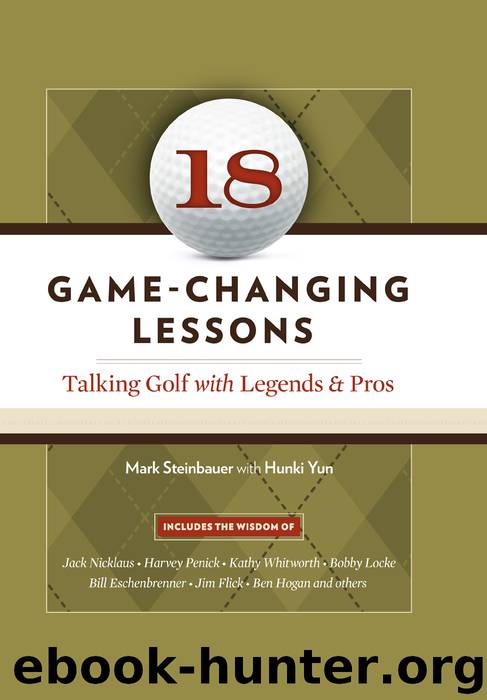
18 Game-Changing Lessons by Mark Steinbauer
Author:Mark Steinbauer
Language: eng
Format: epub
Publisher: Abrams
Published: 2014-12-27T05:00:00+00:00
There has never been a better swing thought in golf than “Take dead aim.” In fact, those three words make up what is the most memorable lesson from Harvey Penick’s Little Red Book.
I heard Harvey give this advice to many students, and I myself have used it often while playing. I found it most useful in uncomfortable situations: during tournaments and periods in which I was making changes to my swing. In those cases, the tendency is to focus too much on swing mechanics or the scorecard: Where is my ball position? Is my swing too upright? Do I need to make a birdie on this hole?
Any experienced golfer can tell you that overthinking is the quickest way to have your round go downhill. Golfers play their best when they are in the zone, a state in which they play with seemingly no thoughts at all.
The beauty of “Take dead aim” is that it eliminates all thoughts except the target itself, which, when you think about it, should be exactly what you’re focusing on anyway. After all, golf is a target-based game, whether your target is the flagstick, a portion of the fairway, or the hole itself.
When the stakes are big enough, even tour pros have trouble with short putts. At the 2001 U.S. Open at Southern Hills Country Club in Tulsa, Oklahoma, Retief Goosen had a one-shot lead as he teed off on the difficult par-four finishing hole. All he needed was a par to win. After a good drive, Goosen hit a great iron to twelve feet, seemingly all but wrapping up his first major championship. After all, a tour pro like Goosen could probably two-putt from twelve feet with his eyes closed.
He hit his first putt well, and it nearly went in. The ball finished less than two feet past the hole, a virtual tap-in. In a casual match or in a match-play event, an opponent would have conceded Goosen a putt of that distance.
But Goosen missed the putt to make bogey and fell into a tie with Mark Brooks. Fortunately, he won the eighteen-hole playoff the next day to win the first of his two U.S. Open titles.
But Goosen might have won a day earlier had he focused on the target and just tapped the ball into the hole. This positive thought would have kept Goosen from dwelling on the negatives, such as the consequences of a missed putt.
The best example of a player with positive focus is Tiger Woods, the most mentally strong player I have ever watched play the game. Dating back to his junior days, Woods has made the putts he had to make on the last couple of holes, especially in the biggest events.
Woods owes much of his mental toughness to his late father, Earl, a former Green Beret. Earl was a good player, but he left the swing instruction of his son to qualified teachers. Instead, Earl subjected young Tiger to a rash of games-manship so that he would not be rattled by any situation on the course.
Download
This site does not store any files on its server. We only index and link to content provided by other sites. Please contact the content providers to delete copyright contents if any and email us, we'll remove relevant links or contents immediately.
Periodization Training for Sports by Tudor Bompa(8411)
Bodyweight Strength Training by Jay Cardiello(8026)
Therapeutic Modalities for Musculoskeletal Injuries, 4E by Craig R. Denegar & Ethan Saliba & Susan Saliba(7778)
Born to Run: by Christopher McDougall(7245)
Imperfect by Sanjay Manjrekar(5931)
Wiseguy by Nicholas Pileggi(5921)
Shoe Dog by Phil Knight(5382)
Paper Towns by Green John(5313)
The Body: A Guide for Occupants by Bill Bryson(5271)
The Rules Do Not Apply by Ariel Levy(5078)
Endurance: Shackleton's Incredible Voyage by Alfred Lansing(4911)
Tuesdays with Morrie by Mitch Albom(4904)
Bodyweight Strength Training Anatomy by Bret Contreras(4757)
The Sports Rules Book by Human Kinetics(4511)
Machine Learning at Scale with H2O by Gregory Keys | David Whiting(4449)
Yoga Anatomy by Kaminoff Leslie(4442)
Dynamic Alignment Through Imagery by Eric Franklin(4339)
Science and Development of Muscle Hypertrophy by Brad Schoenfeld(4238)
Exercise Technique Manual for Resistance Training by National Strength & Conditioning Association(4176)
